Sleep Training, Mental Health, and Exhausted Parents: Can We Talk About the Contradiction?
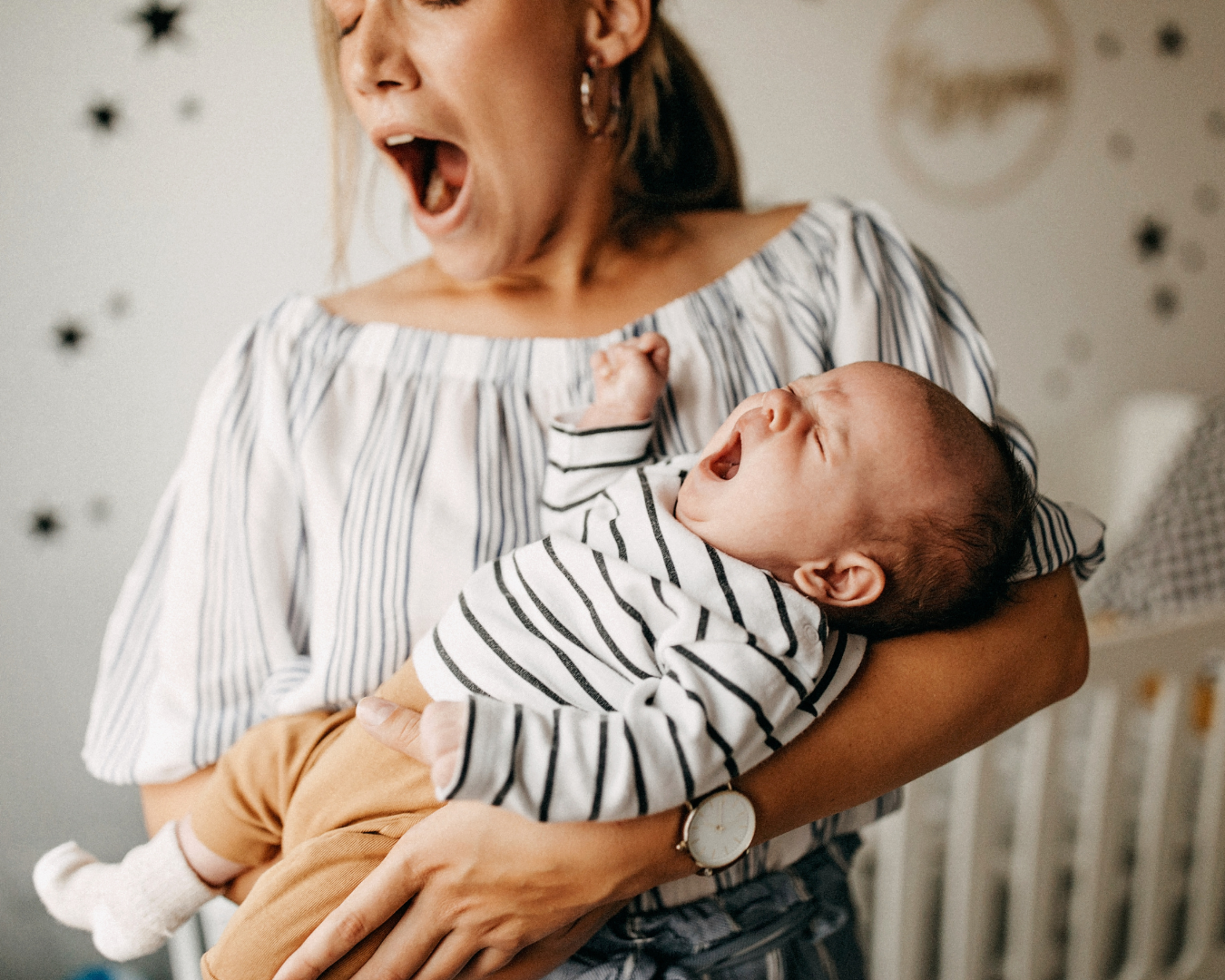
If you've spent any amount of time on social media lately, you've probably noticed that sleep training has become one of the most controversial parenting topics on the internet.
On one side, you'll hear people say that sleep training is harmful, that babies should never cry, and that parents should avoid teaching independent sleep altogether. On the other side, you'll see exhausted parents desperately searching for ways to get more rest because they're running on two or three hours of broken sleep every night.
Then, almost in the same breath, social media reminds parents that mental health matters. We encourage mothers to ask for help. We talk openly about postpartum depression and anxiety. We remind parents to take care of themselves because you can't pour from an empty cup.
And honestly...
I think there's a contradiction we need to talk about.
Before I go any further, I want to be very clear about something. This article is not about convincing every family to sleep train. I don't believe every family should sleep train because I don't believe every family is the same. I've worked with families who sleep train, families who don't, families who co-sleep, and families who room-share. I've worked with babies who respond beautifully to independent sleep and babies who need a completely different approach.
My job has never been to tell parents how they should parent.
My job is to educate families so they can make informed decisions that work for their child, their values, and their family.
What I struggle with is watching parents be shamed for making those decisions.
Parents Matter Too
One of the things I love most about working with families is that I get to support not just the baby, but the entire family. Sometimes I think parenting conversations become so focused on babies that we unintentionally forget there are adults in the home too. Parents are human beings with needs of their own. They need to eat, shower, sleep, connect with their partners, and simply exist outside of meeting someone else's needs 24 hours a day. Supporting children should never require us to ignore the well-being of the adults raising them.
That's where I think our conversations around sleep have become disconnected from reality. We celebrate parents for prioritizing their mental health. We encourage therapy, asking for help, leaning on support systems, and recognizing the signs of burnout. We remind new moms that they can't pour from an empty cup, and I wholeheartedly agree with those messages. But then, when a parent says they're considering sleep training because they are physically and emotionally exhausted, the conversation often changes. Suddenly they're told they're selfish, lazy, or damaging their attachment with their child.
If we truly believe parental mental health matters, then we also have to support parents who are making informed decisions to improve their family's sleep. That doesn't mean every family should sleep train. It simply means parents deserve to make decisions for their own family without being shamed for wanting more rest.
Sleep Is One of Our Most Basic Human Needs
One thing I tell families all the time is that sleep is not a luxury—it's one of our most basic human needs. Babies need sleep because it supports healthy growth and brain development. Children need sleep because it helps with learning, emotional regulation, memory, and behavior. Adults need sleep because our bodies and brains simply cannot function well without it. Parents are no exception.
When families are chronically sleep deprived, everything becomes harder. Patience becomes harder. Emotional regulation becomes harder. Making decisions becomes harder. Even simple tasks like preparing a meal, remembering appointments, or having a meaningful conversation can feel overwhelming when you're functioning on broken sleep night after night.
Research has consistently shown that chronic sleep deprivation is associated with increased symptoms of postpartum depression and anxiety and poorer overall parental well-being. While sleep deprivation is certainly not the only factor that contributes to mental health challenges, it is one that deserves attention. That's one of the reasons organizations like the American Academy of Pediatrics emphasize supporting parents' emotional well-being throughout the postpartum period.
Wanting more sleep doesn't make you selfish. It makes you human.
What I Actually See
One of the things I love most about my work is getting to see families on both sides of this journey. I meet them when they're exhausted, overwhelmed, and wondering if life is ever going to feel normal again. Then, weeks later, I get to see what changes once everyone is getting more consistent sleep.
I remember one mom telling me she felt like her son was attached to her every minute of the day. She couldn't nap, barely had time to eat, and taking a shower felt almost impossible. Even washing her hair became something she had to strategically plan. She wasn't asking for luxury or perfection. She simply wanted to do what I call the "regular degular" things that all of us should be able to do every day.
After we worked together, she shared something that has always stuck with me. She said, "I finally feel like I have my life back." Not because parenting suddenly became easy, but because she could wake up before her son and get herself ready for the day. She could sit down after bedtime and eat dinner with her husband. She could finally breathe a little.
Those moments might sound small to someone who hasn't experienced chronic sleep deprivation, but to an exhausted parent, they're everything.
I also notice something else changes. Parents begin trusting themselves again. They feel empowered because they've helped their child learn a new skill, and they start to see the positive impact that better sleep has on the entire family. Many parents tell me their child seems happier, more energetic, and more engaged during the day. Whether that's because everyone is finally getting the rest they need or simply because the household has found a rhythm that works, the difference is often remarkable.
Sleep Training Is Not About Ignoring Your Child
One of the biggest misconceptions I see online is that sleep training means putting your baby in a crib, closing the door, and ignoring them until morning. That simply isn't what I teach, and honestly, it's one of the biggest reasons I think sleep training has become so misunderstood.
To me, sleep training is teaching a child the lifelong skill of falling asleep independently when they are developmentally ready. Just like learning to use a spoon, put on shoes, or eventually ride a bike, learning to fall asleep independently is a skill. Like any new skill, it takes practice, consistency, and support.
Does that process sometimes involve crying? Absolutely. And I think this is where parents are often given unrealistic expectations. Babies and toddlers communicate through crying because they don't yet have the language to tell us they're frustrated, confused, or adjusting to something new. Expecting sleep training to happen without any crying simply isn't realistic.
That doesn't mean we ignore children. It doesn't mean we stop responding to them emotionally. It doesn't mean we abandon them. In fact, throughout the sleep training process, I encourage parents to remain calm, responsive, and emotionally available while still maintaining the plan they've chosen. Supporting a child's emotions and teaching them a new skill can happen at the same time. Those two things are not mutually exclusive.
What Does the Research Actually Say?
One of the reasons I wanted to write this article is because I think there is a lot of misinformation surrounding sleep training. Social media often presents it as an all-or-nothing issue. Either you're protecting your child by never sleep training, or you're somehow damaging them if you choose to teach independent sleep.
The research simply doesn't support such a black-and-white view.
One of the biggest concerns parents share with me is whether sleep training will affect their attachment with their child. That's an understandable concern because every parent wants their child to feel loved, safe, and secure. The good news is that research looking at developmentally appropriate behavioral sleep interventions has not found evidence that these approaches negatively affect a child's emotional development, attachment, or long-term mental health.
In fact, one long-term follow-up study published in Pediatrics followed families for several years after participating in behavioral sleep interventions. Researchers found no evidence of long-term negative effects on children's emotional health, behavior, parent-child attachment, or the parent-child relationship. That's reassuring for families who worry that helping a child learn to sleep independently somehow damages their relationship. You can read more about that study here: Five-Year Follow-up of Harms and Benefits of Behavioral Infant Sleep Intervention: Randomized Trial
Researchers have also found that helping families improve infant sleep doesn't just benefit children—it can benefit parents, too. Studies have shown improvements in maternal mood and reductions in symptoms of postpartum depression after families received behavioral sleep education and support. Again, this doesn't mean sleep training is the answer for every family, but it does remind us that parents' well-being is an important outcome too. Read the study here: Long-term Mother and Child Mental Health Effects of a Population-Based Infant Sleep Intervention.
I think that's a piece of the conversation that's often missing.
There Isn't One "Right" Way to Parent
If you've read any of my other blogs or attended one of my workshops, you've probably noticed a common theme: I don't believe parenting is one-size-fits-all. I don't believe every family should sleep train, and I don't believe every family should co-sleep. I don't believe there's one parenting philosophy that magically works for every child, every parent, or every family.
What I do believe is that parents deserve education, evidence-based information, and the freedom to make informed decisions without feeling like they're failing if their choice looks different from someone else's.
I've worked with families who absolutely love co-sleeping because everyone sleeps well and it works beautifully for their family. I've also worked with families who tried co-sleeping and found that no one was getting quality sleep. I've worked with parents who chose sleep training because they were emotionally and physically exhausted after months of waking every hour, and I've worked with families who decided to wait because that felt like the right decision for them.
None of those families were wrong.
They were simply making the best decisions they could based on their child's temperament, their own mental health, and what was sustainable for their family.
Sometimes we unintentionally create the idea that "good parenting" means choosing the hardest path. But parenting isn't about proving how much you can sacrifice. It's about raising healthy children while also caring for yourself along the way. If something is no longer working for your family, it's okay to make a change. That change might be sleep training. It might be asking grandparents to help for a night. It might be hiring a postpartum doula or a sleep consultant. Or it might simply be deciding that your current routine is working just fine.
The goal isn't to parent exactly like someone else. The goal is to create a home where both children and parents can thrive.
Let's Stop Shaming Parents
One thing I wish would disappear from parenting conversations is the pressure to choose sides. Somewhere along the way, parenting became less about supporting one another and more about defending our own choices.
You have to sleep train.
You should never sleep train.
You have to breastfeed.
You should formula feed.
You should baby wear.
You should never use a container.
Every decision seems to come with an opinion, and unfortunately, those opinions are often shared in ways that leave parents feeling guilty instead of supported.
The truth is that most parents aren't trying to find the easiest way to parent—they're trying to find the healthiest and most sustainable way to care for their family. They're making decisions based on their child's needs, their family's circumstances, their support system, and sometimes simply what allows everyone in the home to function.
I think we need more grace for one another.
It's okay if one family chooses not to sleep train because everyone is sleeping well and they're happy with their routine.
It's also okay if another family chooses developmentally appropriate sleep training because months of broken sleep are affecting their physical and emotional well-being.
Those two choices can exist at the same time.
Supporting one family's decision should never require criticizing another family's decision.
As parents, we're all trying to raise kind, healthy, resilient children. That common goal should bring us together instead of dividing us.
A Final Thought
If you've made it this far, I hope one thing is clear: this article isn't really about sleep training.
It's about giving parents permission to make informed decisions without carrying the weight of someone else's judgment.
If your family chooses not to sleep train, I genuinely support that decision.
If your family chooses to sleep train when your child is developmentally ready, I support that too.
My hope is that we stop treating parenting as though there's only one "right" way to do it. There isn't. Every child is different. Every parent is different. Every family has different values, different challenges, and different needs.
What works beautifully for one family may not work for another, and that's okay.
At the end of the day, my role isn't to convince parents to sleep train or to convince them not to. My role is to help families make informed, evidence-based decisions that support both their child's development and their own well-being.
Because here's what I know after years of working with children and families:
Children deserve responsive, loving caregivers.
Parents deserve support.
And both children and parents deserve sleep. ❤️